
AI in the studio: where it speeds us up, where we don't trust it
 Siddhant AryanLead Designer · AI Automation
Listen to this article
The short answer
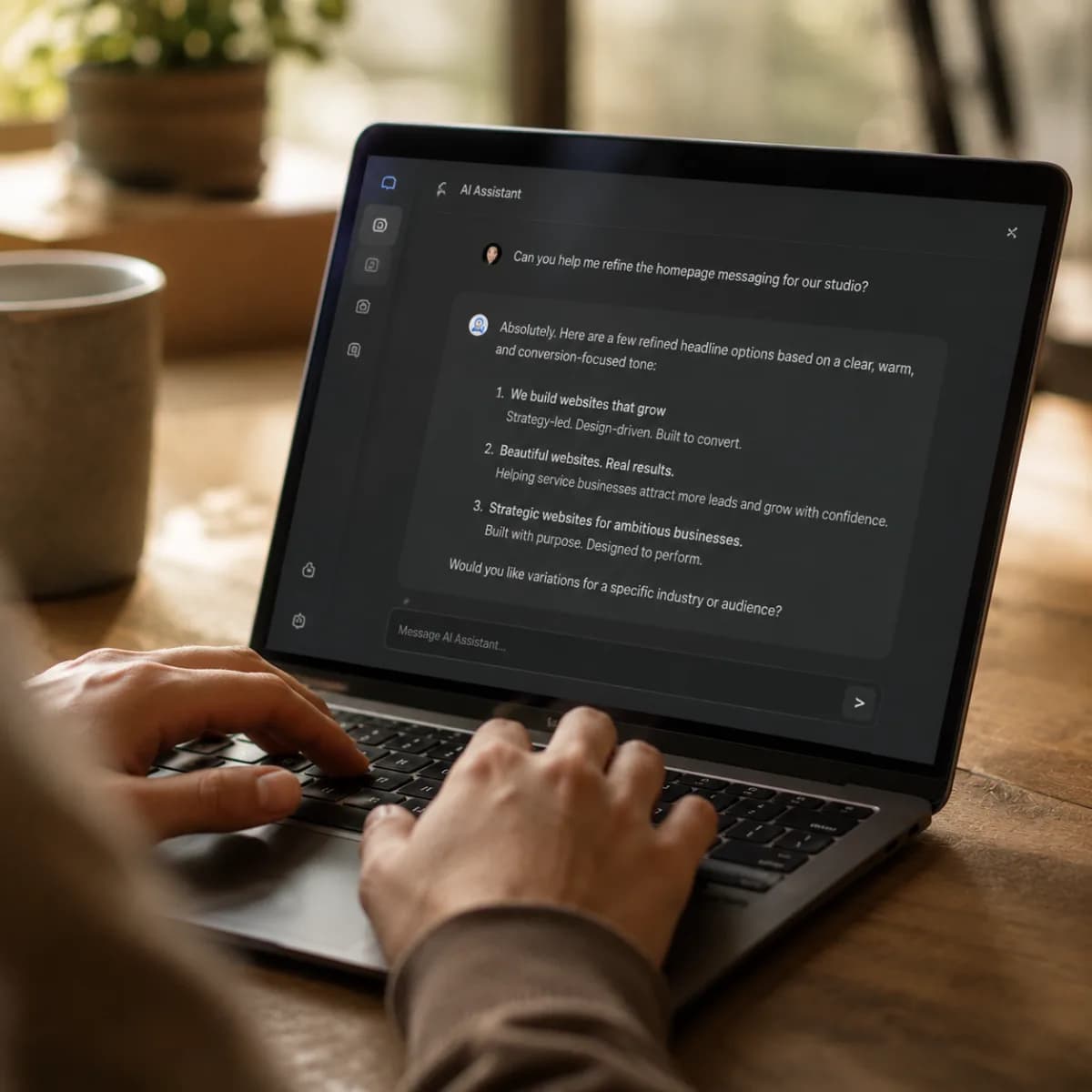
We use AI for first drafts, variations, research summaries and repetitive production — the work between ideas. We deliberately keep humans in charge of strategy, taste, brand voice and the final word on anything a client sees, and everything AI touches is verified by the person responsible for it. That split is the whole policy: machine speed on the busywork, human judgement on the decisions.
On this page
We're an AI-enabled studio, but that doesn't mean AI everywhere. The useful question isn't 'can AI do this' — it's 'where does AI make us faster without making the work worse'.
Where it speeds us up
First drafts, variations, boilerplate, summarising research, and repetitive production work. AI removes the blank page and the busywork so we spend our time on judgement.
In practice that looks like: ten headline directions instead of three, competitor research condensed before a strategy call, alt text and resize variants generated in minutes, and boilerplate code scaffolded so a developer starts at the interesting part. None of that output ships as-is — it collapses the distance between 'blank file' and 'something worth reacting to'.
Where we keep humans in charge
Strategy, taste, brand voice, and the final word on anything a client sees. AI doesn't own the decision — it accelerates the path to one.
The reason is simple: AI averages. It's trained on everything, so left alone it produces the most statistically typical version of your industry's marketing — which is exactly what a brand exists to not be. Positioning, the one insight a campaign hangs on, the sentence that sounds like the founder — that's human work, and clients are paying for precisely that.
| AI accelerates | Humans own |
|---|---|
| First drafts & variations | Strategy & positioning |
| Research summaries | The core creative idea |
| Resizes, exports, boilerplate | Brand voice & taste |
| Meeting notes & documentation | Anything a client signs off |
Always verified
Anything AI touches gets checked by the person responsible for it. The speed is only worth it if the standard holds.
Verification is a named responsibility, not a vibe: the designer owns what the design tools produced, the writer owns every generated sentence, the developer owns generated code. 'The AI did it' is not an accepted explanation in this studio — which, more than any tool choice, is what keeps the quality bar where clients expect it.
Why this matters to clients
Agencies that hand work to AI unsupervised get cheaper and worse at the same time. The point of AI in a studio is to spend more hours on judgement, not fewer hours on the work.
Key takeaways
- Use AI for drafts, variations and busywork — it removes the blank page, not the decision.
- Keep humans on strategy, taste and final calls, because AI averages and brands need to be exceptions.
- Verify everything AI produces, with a named owner — speed only counts if the standard holds.
Frequently asked questions
Does Global Info Edge use AI to produce client work?
We use AI to accelerate drafts, variations, research and repetitive production. Everything a client sees is directed, edited and approved by a human specialist — AI shortens the path to the decision, it never makes the decision.
Will AI-assisted work all look the same?
Only if you let the model lead. AI produces the average of its training data, so we feed it our strategy, the client's voice and real specifics — then edit hard. The tool multiplies inputs; distinctive inputs are the job.
Is AI-generated content bad for SEO?
Google's position is that it rewards helpful content regardless of how it's produced — and penalises mass-produced, unedited filler. AI-assisted content with real expertise, editing and first-hand detail ranks; raw AI sludge increasingly doesn't.
Does using AI make agency work cheaper?
It changes where the hours go. Production gets faster, so more of the budget buys thinking — strategy, testing, iteration — instead of mechanical output. Quality-focused studios convert AI savings into better work, not just lower invoices.
What AI tools does the studio actually rely on?
A small, stable set: LLMs for drafting and research, image tools for exploration and production variants, and automation (like N8N) for the operational busywork around projects. We adopt a tool only when it survives real client work — not because it's new.
Tools & next steps
Put this into practice, go deeper, or see how we'd do it for you.
Written by

Mr. Siddhant Aryan
Lead Designer & AI Automation, Global Info Edge
Lead designer and AI-automation specialist at Global Info Edge with 5 years building fast, conversion-focused websites and the workflows that run behind them.
View full profile