
AI Overviews are eating your clicks. Why I'm not panicking — and what we do instead
 Chandan KumarFounder · Performance Marketing Specialist
Listen to this article
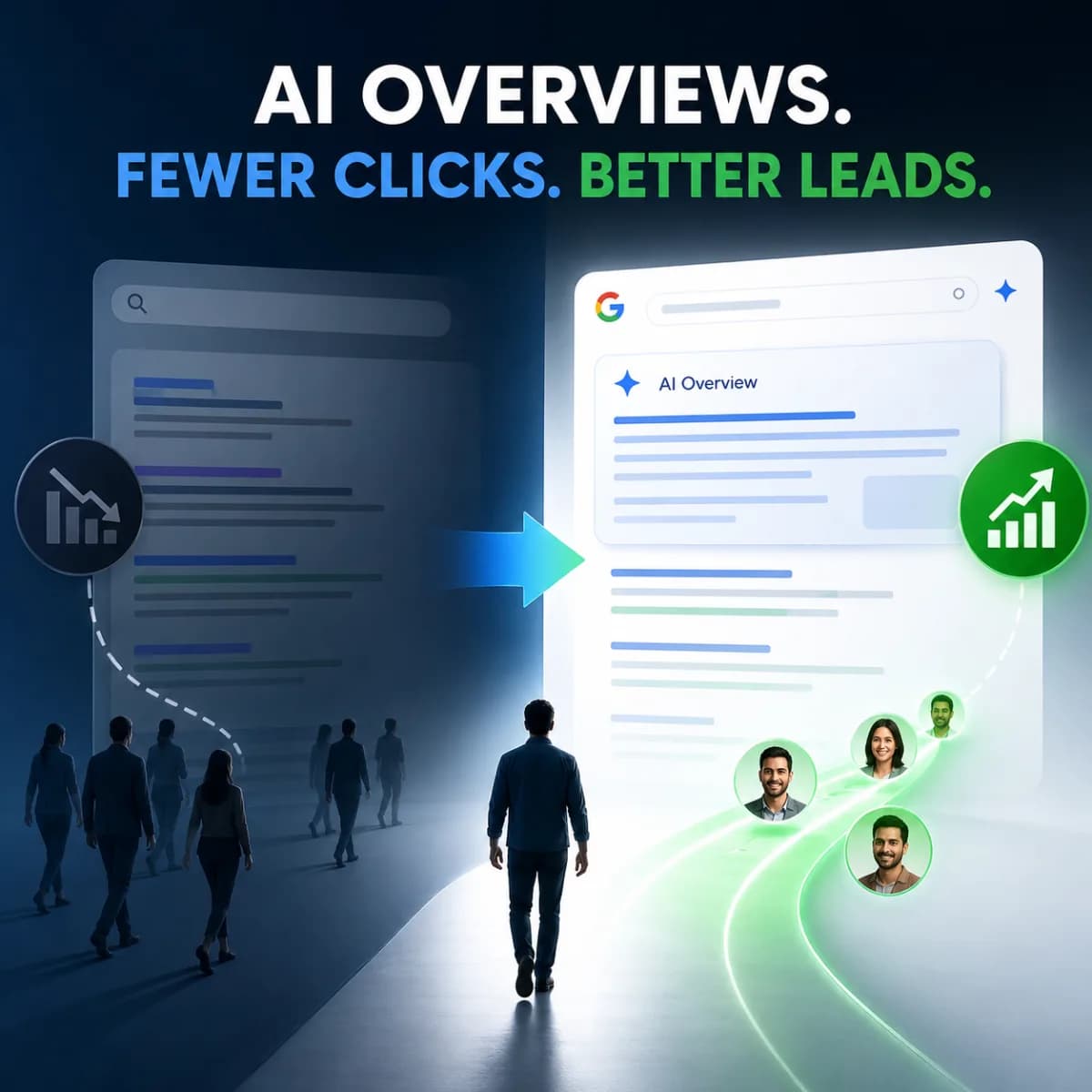
The short answer
AI Overviews and ChatGPT are cutting search clicks hard — but that's only one column of the data. The traffic that still clicks through converts dramatically better, because the casual "what is X" searcher now gets their answer in the AI box and never needed you, while the person who clicks has a real, specific need the summary couldn't satisfy. So: stop reporting sessions and judge by leads and revenue; optimise to be the source the AI cites (GEO/AEO — clear answers, entity signals, reviews, a strong Google Business Profile); defend branded and high-intent paid search, which matters more as organic clicks shrink and each click costs more; and play the long game of being the brand the AI recommends, built the slow way through real reviews, mentions and a consistent presence. Fewer visitors, better visitors.
On this page
The numbers coming out of search right now are genuinely alarming if you only read one column of them. AI Overviews are showing on roughly 18% of Google searches and climbing. When that box appears, click-through to actual websites has fallen from around 15% to about 8% — close to a 47% collapse in clicks reaching publishers. Sixty percent of searches now end with no click at all. Gartner has been forecasting search volume dropping a quarter by 2026, and ChatGPT is busy answering the questions people used to type into Google. Every week a founder forwards me one of these stats with a worried note. And every week I tell them the same thing: read the other column before you panic.
Traffic is down — but you're watching the wrong number
Here's the column nobody screenshots. The traffic that still makes it through from AI search converts dramatically better — by some measures around 14% versus under 3% for traditional search, with roughly 42% higher conversion, more revenue per visit, lower bounce and longer time on site. Fewer people are arriving, and the ones who do are far closer to buying. That's not a catastrophe; it's a re-sort of who bothers to click.
Think about why. The casual searcher — 'what is X', 'how does Y work' — gets the answer in the AI box and never leaves. They were never going to buy from you this week anyway; they were tyre-kickers padding your analytics. The person who still clicks through has a real, specific need the summary couldn't satisfy. So when a founder shows me a scary drop in sessions, my first question is always: what happened to leads and revenue? Nine times out of ten they're flat or up. If you're still reporting pageviews to your board in 2026, you're measuring the era that just ended.
By the numbers
The traffic that still arrives from AI-mediated search converts far better than old-style search clicks — fewer visitors, but much closer to buying, with lower bounce and longer time on site. A drop in sessions next to flat-or-rising leads isn't a crisis; it's the analytics shedding the tyre-kickers who were never going to buy. Watch leads and revenue, not pageviews.
Win the citation, not just the ranking
The new game isn't only ranking on a page of blue links — it's being the source the AI quotes. If ChatGPT or Google's AI Overview names your brand in its answer, you get the trust and the mention even when there's no click, and you become the obvious destination when a click does happen. This is what people are clumsily calling AEO or GEO — optimising to be the answer, not just to appear somewhere near it.
Practically, that means content that genuinely, clearly answers real questions — structured, specific, and trustworthy enough for a model to lean on — plus the entity signals that make you a recognised brand: consistent information, schema, reviews and mentions across the web. For the Indian local businesses we work with, this overlaps heavily with Google Business Profile and review volume, because that's a lot of what the AI draws on when it recommends 'the best clinic in Indiranagar' or 'a reliable tour operator in Manali'. Being citable is the new being-rankable.
What is GEO / AEO (being the answer)?
GEO (generative engine optimisation) and AEO (answer engine optimisation) mean optimising to be the source an AI quotes or recommends, not just to rank on a page of links. You win it with content that clearly answers real questions plus entity signals — consistent information, schema, reviews and mentions across the web — that mark you as a recognised, trustworthy brand. Being citable is the new being-rankable.
Paid search changes shape — defend and capture
For performance marketing specifically, the zero-click shift makes paid placement more important, not less. When organic clicks shrink and the AI box pushes the classic results further down the page, the paid slots that sit above or around that box become some of the only reliable ways to capture a high-intent searcher at the exact moment of need. The click is scarcer and, yes, often pricier — which changes the maths of what you do with it once you've got it.
It also makes branded-search defence non-negotiable: when someone has heard of you from an AI answer and then searches your name, you cannot afford to lose that click to a competitor's ad sitting on top of it. And because every paid click now costs more in a thinner market, the old full-funnel discipline matters more than ever. A scarcer, pricier click landing on a slow page with no follow-up is a far more expensive mistake in 2026 than it was in 2022. Fewer shots means each one has to be set up to convert.
The long game: be the brand the AI recommends
Step back and the real shift is this — AI search rewards brands, not pages. The model recommends names it 'trusts', and that trust is built the slow way: real reviews, genuine mentions, a consistent presence, customers who actually had a good experience and said so publicly. You cannot growth-hack your way into an AI's recommendation the way you could once hack your way up a results page with thin, keyword-stuffed pages.
That's why I keep telling founders this is a brand-and-performance moment, not a choice between them. The performance work captures and converts the demand that's there today; the brand work makes you the answer the AI offers tomorrow. The businesses that come out of this shift ahead aren't the ones chasing the lost clicks — they're the ones building the reputation that makes an AI hand them the customer. Fewer visitors, better visitors, and a brand the machine wants to recommend. Optimise for that, and the scary column stops mattering.
Key takeaways
- Stop reporting sessions; in the AI-search era, judge by leads and revenue from better-qualified visitors.
- Optimise to be cited (AEO/GEO) and defend branded and high-intent paid search aggressively.
- Fewer, costlier clicks reward a sharp offer, a fast page and instant follow-up — and a brand the AI trusts enough to recommend.
Frequently asked questions
Are AI Overviews killing SEO traffic?
They're cutting click volume — AI Overviews appear on a large share of searches and roughly halve click-through where they show — but they're not killing the value of search. The traffic that still clicks through converts far better, because the casual researcher gets their answer in the box while the person who clicks has a real, specific need. So sessions fall but leads and revenue usually hold or rise. Judge the impact on outcomes, not pageviews.
What is GEO and AEO?
GEO (generative engine optimisation) and AEO (answer engine optimisation) are the practice of optimising to be the source an AI cites or recommends, rather than just ranking on a page of blue links. You earn it with content that clearly and specifically answers real questions, plus entity signals — consistent business information, schema, reviews and mentions across the web — that make you a recognised brand. For local businesses, a strong Google Business Profile and steady reviews are a big part of it.
Should I report sessions or leads in the AI-search era?
Leads and revenue. Sessions are increasingly misleading because the AI box absorbs the low-intent 'what is X' traffic that was padding your analytics anyway. A drop in sessions sitting next to flat or rising leads is the system working — you're getting fewer but better-qualified visitors. If you're still reporting pageviews to your board, you're measuring the era that just ended; switch the scoreboard to outcomes.
Does paid search still matter with AI Overviews?
More than before. As organic clicks shrink and the AI box pushes classic results down the page, the paid slots around that box become one of the few reliable ways to capture a high-intent searcher at the moment of need. It also makes branded-search defence non-negotiable — when someone hears of you from an AI answer and searches your name, you can't lose that click to a competitor's ad. Each click is scarcer and pricier, so the page and follow-up behind it have to be sharp.
How do I get my brand recommended by AI?
Build the reputation the slow, real way, because AI search rewards brands, not thin pages. That means genuine reviews, real mentions across the web, consistent business information, and customers who had a good experience and said so publicly. You can't growth-hack your way into an AI's recommendation the way you once could climb a results page with keyword-stuffed pages. Pair that brand work (which makes you the answer tomorrow) with performance work (which captures the demand that exists today).
Tools & next steps
Put this into practice, go deeper, or see how we'd do it for you.
Written by

Mr. Chandan Kumar
Founder & Performance Marketing Director, Global Info Edge
Founder of Global Info Edge and a performance-marketing specialist with 18+ years — Google & Meta ads, conversion funnels and measurable growth.
View full profile